Tengu no hanazuke


Efter sin hanazuke 1 kan svart förbinda de tre stenarna i hörnet med utsidan.

Denna tesuji kallas tengu no hanazuke, vilket syftar på att stenen spelas mot "nästippen" på den vita gruppen.

Exemplet är hämtat ur Sakata Eios Tesuji and Antisuji of Go, som härmed rekommenderas. Där översätts termen med "the goblin's nose attachment" medan John Fairbairn (i rec.games.go) har föreslagit "Tweaking the Goblin's Long Nose".
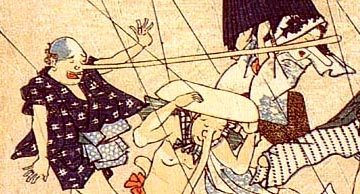
Tengu beskrivs på följande sätt i Basil Hall Chamberlains bok Japanese Things (5th revised edition, 1905):

a class of goblins or gnomes that haunt the mountains and woodlands, and play many pranks. They have an affinity to birds; for they are winged and beaked, sometimes clawed. But often the beak becomes a large and enormously long human nose, and the whole creature is conceived as human, nothing birdlike remaining but the fan of feathers with which it fans itself. It is often dressed in leaves, and wears on its head a tiny cap.
Och så här berättar F. Hadland Davis i Myths & Legends of Japan (1913):

The Tengu is still believed to inhabit certain forests and the recesses of high mountains. Generally speaking, the Tengu is not a malevolent being, for he possesses a keen sense of humour, and is fond of a practical joke. Sometimes, however, the Tengu mysteriously hides human beings, and when finally they return to their homes they do so in a demented condition. This strange occurrence is known as Tengu-kakushi, or hidden by a Tengu.
Detta tengus en aning irriterande beteende ledde till att myndigheterna i Edo (Tokyo) inför ett besök av shogunen satte upp ett plakat av följande lydelse:

"TO THE TENGU AND OTHER DEMONS

"Whereas our Shôgun intends to visit the Nikko Mausolea next April, now therefore ye Tengu and other Demons inhabiting these mountains must remove elsewhere until the Shôgun's visit is concluded.

"(Signed) MIZUNO, Lord of Dewa.
"Dated July 1860"

The local officials were not content with a notice of this kind. After duly notifying the Tengu and other demons of the coming of the Shôgun, the exact mountains were specified where these creatures might live during the ruler's visit.
Det kanske inte är någon slump att den panterfläckiga flugsvampen (Amanita pantherina) heter tengutake på japanska. Som matsvamp bör man hellre välja shiitake eller, om man är rik, matsutake...

Tenguzaru är en näsapa.


Tenguparodi av Utagawa Kuniyoshi (1797-1861)
Bakgrundstengu av Katsushika Hokusai (1760-1849)