

Facts about Leksand and Dalarna
Lake Siljan
Siljan is Sweden's sixth largest lake, 354 km2. It is located at the centre of the crater that was formed when a meteorite hit the earth 370 million years ago. From some elevated spots it is still possible to see clearly the 40 km wide circular rim of the original crater. The area around Siljan is rural and peripheral with respect to major Swedish population centres, but it is deeply rooted in Swedish tradition. The homeland of free yeomen, this is the region to which any political party always turned for armed support in ancient times when they wanted to make the case that freedom and national independence were being threatened. Traditional sources of income have been based on pasture, forests and mining (the area was the world's leading copper producer in the 17th century). Habits have remained strongly traditional until recent times and the area is famous for its craftsmanship and traditional flowery decorative painting. To national romantics in the late 19th century, the Siljan region was the most truly Swedish part of Sweden.

Photo: www.siljan.se View of siljan
|
Leksand
Leksand is a town in Dalarna with about 16 000 inhabitants. The name is known since 1318 and is composed of the word “lek” (appropriately play or mating) and “sand” and refers to the fish mating at the sandy bottom of the lake. The church in Leksand dates back to around 1300.
Today Leksand is characterised by small industry and enterprise as well as summer tourism.

Photo: www.siljan.se View over Leksand
|
The right of public access
Swedish law provides extensive right of public access to land and waters. It is allowed to walk, cycle, ride, swim, move around in unpowered boats and camp practically everywhere, provided that you don't disturb people or destroy anything. It is allowed to pick wild flowers, berries, mushrooms and such like everywhere, or to collect dead wood and make a fire, provided that adequate safety measures are taken.
These rights obviously entail duties like exercising your judgement not to destroy anything or litter.
Special rules apply to fishing and hunting. As for fishing in Siljan, the river Dalälven and in the many small lakes and creeks in the area, you need in principle to buy a fishing license for the particular area. Such licenses may cost around 20 euro per week, please enquire about further details at Siljan Turism.
The horse
The symbol of the 2008 congress is the traditional wooden horse of the Dalarna region. Originally the painted horses were toys, which were manufactured in the Siljan region and sold throughout Sweden from early 18th century. The horse represents a strong tradition in craftsmanship and decorative art in the region. At the world exhibition in New York in 1939 the characteristic painted horse was chosen as a symbol for Sweden as a whole.
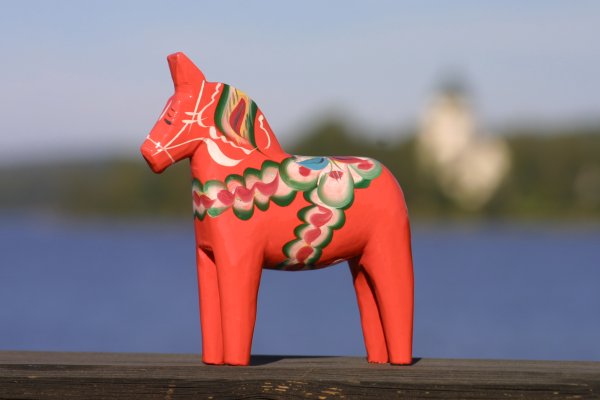
Photo: www.siljan.se Dalecarlian horse
|
Red houses
Houses in the central regions of Sweden are often painted in a characteristic red. The essential pigment was originally obtained as a byproduct from the mining and manufacture of copper in Dalarna. Mining for copper in the region started some time between 850 and 1080 AD and in the 17th century the region accounted for more than 60% of the world production of copper. The production of the red paint started in 1616.

Photo: www.siljan.se Red houses
|
Maypoles
To erect a maypole, a wooden pole decorated with leaves and flowers, was a common custom to celebrate the arrival of spring and summer in northern Europe already in ancient times. In Sweden, probably for climate reasons, the maypole was moved forwards a bit to the Midsummer celebration (whereas the bonfire that was customary at Midsummer elsewhere was moved back to the end of April in Sweden). The use of maypoles was imported to Sweden from Germany in the Middle Ages. Midsummer is one of the most important celebrations in Sweden, probably with roots already in pagan times. In the Siljan region the maypole and Midsummer traditions are particularly strong, and the maypoles here are left erect the whole year, until it is time to redecorate them again for Midsummer.


Photo: www.siljan.se Maypole
|
Midsummer
|
Dalecarlian painting
Dalecarlian painting (or kurbits painting) is a form of Swedish peasant culture that flourished between late 18th century and mid 19th century and has left deep traces. That was the period when self-taught peasants from Leksand and Rättvik decorated the farms in many parts of Sweden. Dalecarlian painting was linked to important moments in life, the paintings and commemorative tablets were created on the occasion of weddings and high festivals of the year. Popular subjects were taken from the holy scriptures, such as this picture, which shows Jesus Christ entering Jerusalem. There is a permanent exhibition of Dalecarlian painting in the Leksand cultural house, which has the third largest collection of Dalecarlian painting.

Dalecarlian painting
|